


There's something satisfying about taking action when it comes to your investments. The market drops, so you reduce your stock exposure. A particular sector takes off, so you increase your allocation. An investment underperforms for a few quarters, so you replace it with something that seems more promising.
Each decision might seem perfectly reasonable at the time. After all, shouldn't a responsible investor be paying attention?
The problem is that a series of individually reasonable decisions can produce a surprisingly expensive long-term outcome. And unlike investment management fees, which typically appear on your statements, the costs of constantly adjusting your portfolio can be much harder to recognize.
The Difference Between Being Engaged and Being Reactive
Successful investing doesn't require ignoring your portfolio. In fact, thoughtful portfolio management involves ongoing research, monitoring, and periodic adjustments. But there's an important distinction between making changes because your financial circumstances or investment assumptions have changed and making changes because you're uncomfortable with what the market is doing.
For example: think about an investor who has a diversified portfolio designed around a 15-year investment horizon. During a market downturn, they shift a portion of their investments into cash, intending to reinvest when conditions improve. The initial decision might feel correct, but now they've created two additional decisions: when to get back into the market and what to buy when they do.
Suddenly, a long-term investment strategy has become a series of short-term predictions. And getting those predictions right consistently is extraordinarily difficult.
What the Research Says About Investor Behavior
The cost of investment decisions isn't just theoretical. Research consistently shows that investors often earn less than the investments they own.
According to Morningstar's 2026 Mind the Gap study, the average dollar invested in U.S. mutual funds and ETFs earned an annualized return of 8.7% over the 10 years ending December 31, 2025. The funds themselves generated an annualized return of 9.9%. That's a difference of 1.2 percentage points per year, largely reflecting when investors added or withdrew money.
That might not sound dramatic, but consider a hypothetical $500,000 portfolio growing over 20 years with no additional contributions or withdrawals.
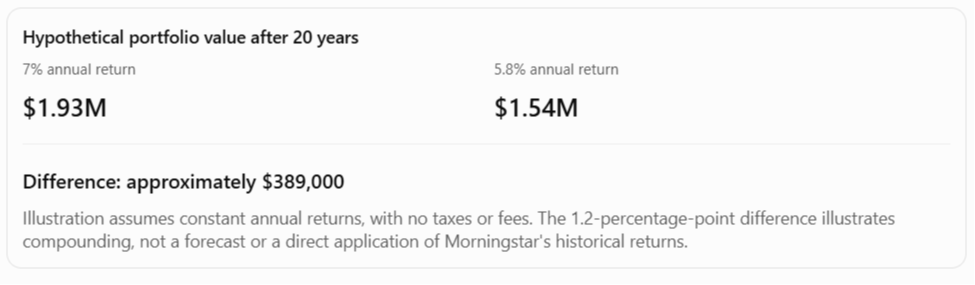
Not every difference in investor returns is caused by emotional trading. Contributions, withdrawals, and financial circumstances also matter. Nevertheless, the research highlights how the timing of investment decisions can materially affect wealth accumulation.
The Three Costs Investors Often Overlook
The consequences of frequent portfolio changes extend beyond simply buying and selling at the wrong time.
- The opportunity cost of waiting for certainty. Investors who move to cash during volatile periods often intend to return when markets stabilize. Unfortunately, some of the strongest market days occur close to the worst ones. Vanguard research illustrates how missing just 10 of the market's best days between 1988 and 2024 could have substantially reduced long-term investment growth.
- The tax cost of unnecessary changes. Selling appreciated investments in a taxable account can trigger capital gains taxes. Even when a replacement investment performs well, the taxes paid today reduce the capital available to compound tomorrow. Investors should evaluate whether the expected improvement justifies accelerating those taxes.
- The cost of constantly changing strategies. Perhaps the least obvious consequence is that frequent adjustments make it difficult to determine whether an investment strategy is actually working. If you're continually changing allocations, managers, or investment styles, you're never giving your original strategy a meaningful opportunity to demonstrate its effectiveness.
When Does a Portfolio Change Actually Make Sense?
None of this means investors should leave their portfolios untouched for decades. There are legitimate reasons to make changes, including shifts in financial goals, risk tolerance, investment valuations, tax circumstances, or the underlying assumptions supporting an investment.
The distinction is whether a change is driven by a deliberate process or a temporary emotional response. Before adjusting your portfolio, consider three questions:
- What has fundamentally changed? Has something changed in your financial situation, investment outlook, or portfolio construction? Or are you simply responding to recent performance?
- What problem will this change solve? Every adjustment should have a clearly defined purpose, whether that's improving diversification, managing risk, or increasing tax efficiency.
- What would convince me to reverse this decision? If you can't identify the conditions under which you'd reconsider a change, you may be reacting rather than following a strategy.
Try documenting the reasoning behind each significant investment decision. Reviewing those notes a year later can reveal whether changes were based on sound analysis or short-term discomfort.
Sometimes the Most Valuable Decision Is Not to Make One
Investors often associate good portfolio management with activity. But thoughtful investment management isn't measured by the number of trades made or how frequently allocations change. It's measured by whether the portfolio continues to serve its intended purpose.
At Principles of Financial Planning, our Principled Portfolios approach emphasizes research-driven investment decisions, disciplined portfolio construction, and ongoing evaluation. We believe portfolios deserve regular attention, but that doesn't mean every market movement requires a response.
Is your portfolio guided by a consistent investment philosophy or the latest market development? Learn more about Principled Portfolios and how our disciplined approach helps keep investment decisions focused on your long-term financial goals.