

At Principles of Financial Planning, investment management isn’t about chasing headlines or guessing what markets will do next. It’s about creating a thoughtful, repeatable process designed with the objective of supporting your long-term goals through growth markets, downturns, and everything in between.
Our approach combines quantitative analysis, diversified portfolio construction, and ongoing oversight to help clients participate in market growth while managing risk along the way.
Why We Invest This Way
Many investors are drawn to “tactical” strategies that seek to sidestep downturns or jump into opportunities at just the right moment. In practice, those approaches often create frustration, missing strong market runs, triggering unnecessary taxes, or adding complexity and cost without improving results.
We designed our investment process to be different.
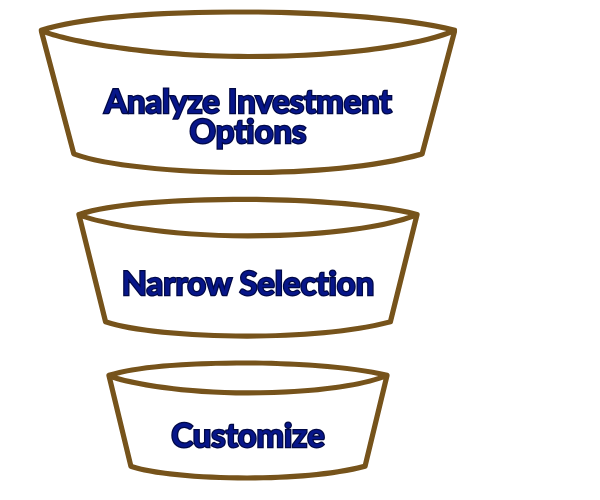
We don’t build portfolios from a limited shelf of investments. Instead, we analyze a broad universe that includes nearly 2,000 exchange-traded funds (ETFs) and more than 4,000 mutual funds.
From there, we narrow down the selection using strict criteria, starting with a strong emphasis on track record. For broadly diversified funds, we typically look for at least 10 years of performance history, while more specialized or niche investments may be considered with a minimum of five years.
This disciplined screening process helps ensure that every investment we include has demonstrated consistency over time.
Our goal is to support long-term compounding by smoothing the investment experience as much as possible, seeking to limit major drawdowns during periods of stress while remaining positioned for growth when markets are favorable. No strategy can eliminate risk or guarantee outcomes, but thoughtful risk management can make a meaningful difference over time.
Clear Risk Levels for Every Investor
We categorize portfolios into four defined risk bands:
 Conservative: prioritizes capital preservation and stability
Moderate Conservative: balances income and modest growth
Moderate: balanced growth with volatility management
Moderate Aggressive: higher equity exposure for long-term growth
This structure helps ensure your portfolio reflects your actual comfort with risk—not just a theoretical questionnaire result.
Ongoing Portfolio Monitoring & Rebalancing
Investment management doesn’t end after implementation. Our process includes:
 Continuous model oversight
Rebalancing when allocations drift
Updates across portfolios when strategy changes are warranted
Alignment with your evolving financial goals
For clients in Greensboro and the surrounding Triad area, this means you have a local advisor actively monitoring your investment strategy—not a set-it-and-forget-it solution.
Tax-Aware Investment Management
For taxable investment accounts, we incorporate tax considerations into portfolio management when appropriate. This may include:

Managing capital gains exposure
Coordinating investment strategy with tax planning
Adapting models for tax-sensitive accounts
Investment decisions impact more than performance—they affect cash flow, retirement income, and long-term tax efficiency.

Accumulation Portfolios (Growth-Focused)
Designed for clients who are building wealth over time, these portfolios emphasize price appreciation.
- Four models range from conservative to more growth-oriented
- Models 2–4 include a tactical overlay that can shift between growth-focused and defensive positions based on data signals
- The goal is to remain invested during favorable conditions while reducing exposure during periods of heightened risk
- The risk assumed by the fund must be justified by the returns gained.

Distribution Portfolios (Income-Focused)
Designed for clients who need steady income—often in or near retirement.
- Emphasis on yield from dividends and interest
- Portfolios are more static, with periodic rebalancing
- Focused on stability, cash flow, and sustainability rather than market timing